Animation requires sustained mental focus and physical coordination. Staring at a blank screen or page without preparation often leads to stiff, hesitant marks and unclear ideas. Professional animators avoid this by beginning sessions with short physical exercises that take less than ten minutes and require no software.
These warm-ups serve a specific purpose. They shift the brain from passive observation to active analysis. They loosen the hand and wrist after periods of inactivity. Most importantly, they train the eye to see motion as a sequence rather than a single frozen image.
Gesture Drawing
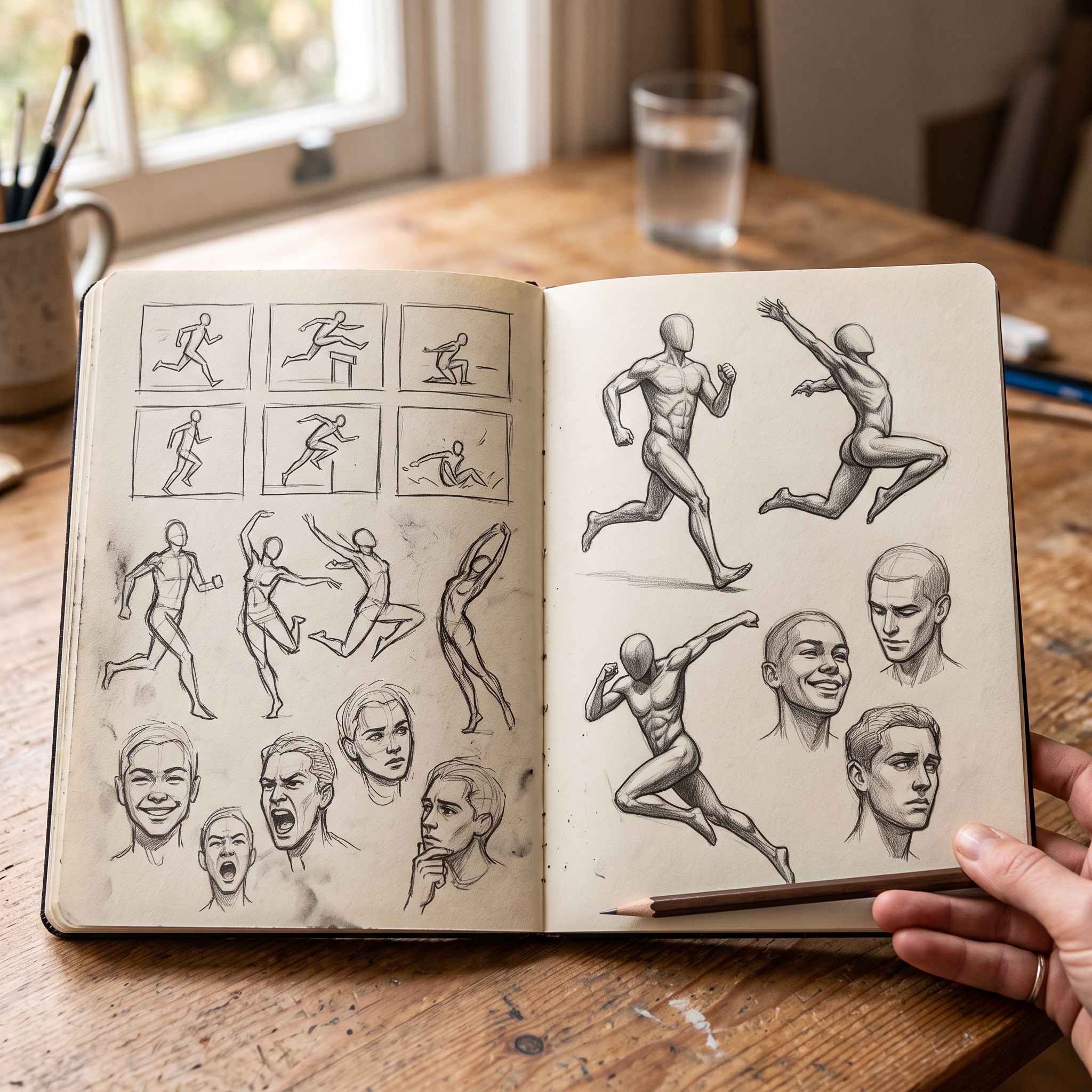
Gesture drawing involves sketching a figure in 30 seconds or less. The goal is not anatomical accuracy. It is capturing the energy, weight, and direction of a pose in its most essential form. A single line might indicate the curve of a spine. Three quick strokes might suggest a leg pushing against the ground.
This exercise teaches economy of line. Animators who practice gesture drawing learn to identify what matters in a pose and discard what does not. That skill translates directly into planning keyframes, where clarity matters more than detail.
Thumbnail Studies
A thumbnail warm-up involves sketching a simple action in four to six small boxes on a single page. A person sitting down. A bird landing on a branch. A ball rolling to a stop. Each box represents a key moment in the sequence.
This exercise trains the eye to think in narrative order. Beginners often try to draw a finished frame before understanding the full action. Thumbnails force the artist to map the entire motion first. They also reduce the pressure of perfection. A one inch sketch is expected to be rough.
Many professional storyboard artists fill pages with thumbnails before touching final panels.
Mirror Observation
The mirror warm-up involves performing an action in front of a mirror, then sketching what was observed. Facial expressions, hand gestures, posture shifts, and weight transfers become clearer when the artist feels them in their own body.
This builds empathy for the subject. An animator who has physically experienced the hesitation before a jump or the imbalance of a stumble can communicate those qualities more convincingly in drawn or digital form. It also provides reference that is free, immediate, and legally uncomplicated.
Paper Still Works
These three exercises require only pencil and paper. Working offline removes the distraction of software interfaces, notification sounds, and the temptation to refine too early. The roughness of the medium is an advantage. It enforces a mindset of exploration rather than production.
A practical habit is to keep a small notebook and pencil near your workspace. Use it before opening any animation software.
Starter Exercise: The 10 Minute Warm-Up
Complete this sequence before your next practice session.
- Set a timer for three minutes. Open a free gesture website or look out a window at people walking. Sketch three different poses, one minute each. Use single lines. Do not erase.
- Set a timer for four minutes. Draw six small boxes in a row, each two inches wide. Sketch a simple action: a cup being lifted to a mouth. Plan the start, the lift, the sip, and the return. One box per key moment.
- Set a timer for three minutes. Stand up. Perform three facial expressions in a mirror: surprise, suspicion, and relief. Sit down and sketch each from memory. Do not worry about likeness. Focus on what the eyebrows, eyes, and mouth did.
Put the sketches aside and begin your main animation work. Over one week, the difference in your starting focus will be noticeable. Start taking your hobbies seriously. Classes start September